

And therefore I have sailed the seas and come
W.B. YEATS
To the holy city of Byzantium.
O sages standing in God’s holy fire
As in the gold mosaic of a wall,
Come from the holy fire, perne in a gyre,
And be the singing-masters of my soul.”
A majestic black stallion rears atop a misty ridge, its silhouette cast in bold relief against the glowing sky. The air is thick with ethereal tendrils of fog that curl around the nearby hills, as if the land itself is draped in a veil of gossamer. The sunlight dances across the landscape, casting long shadows behind the hills and illuminating the clouds in a golden halo. The water of the bay shimmers and glows, rippled by delicate filaments of light that flicker like flames on its surface.
The light captured in the image above originated in a massive cloud of gas and dust in the Orion Arm of the Milky Way galaxy some 1,750 years ago, when the great city of Constantinople (present day Istanbul), heart of the Byzantine empire, was still relatively young. Known as the Orion A molecular cloud, it is one of the most active and well-studied star-forming regions in our galaxy and home to some of the most famous and recognizable celestial objects. The Great Orion nebula may be the most iconic and well-known deep sky object, but the Horsehead Nebula is undoubtedly the most recognizable.
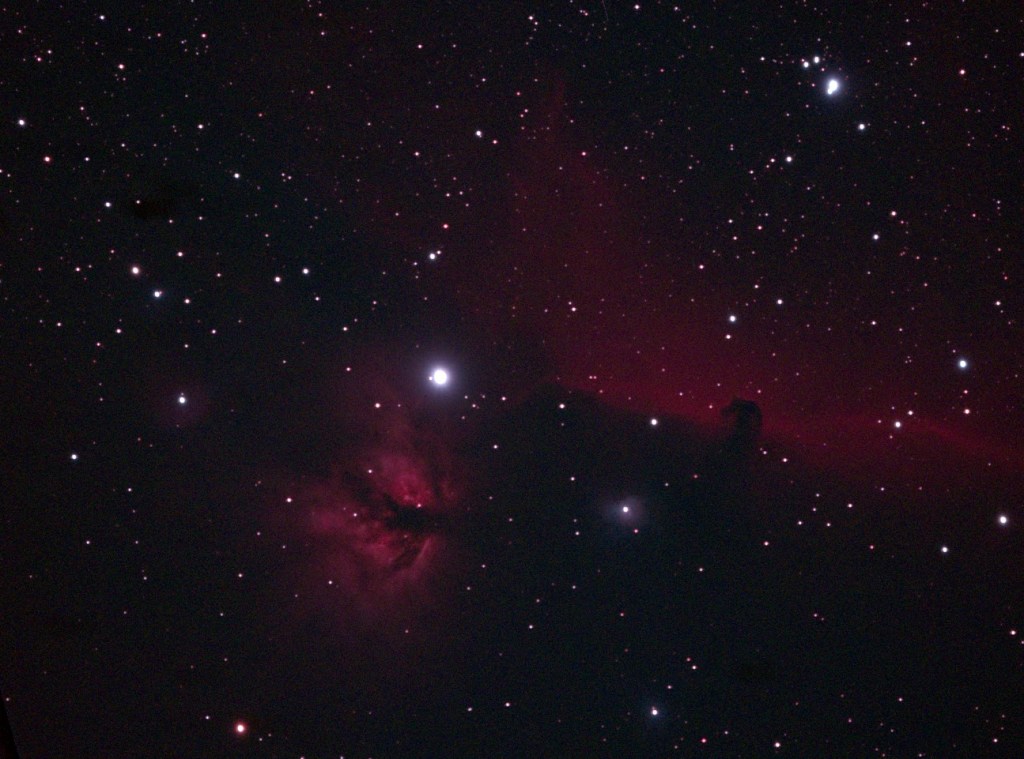
The “stallion” is an immense opaque cloud of dust and gas nearly four light-years in length, erupting out of a ridge of glowing ionized hydrogen gas illuminated by energetic stars of the nearby σ (Sigma) Orionis cluster, just outside of the field of view. At the center of it all is the brilliant Alnitak with its halo, one of the three bright stars of Orion’s belt. Just below that is the brightly burning Flame Nebula, with its thick tendrils of smoky dust snaking through and obscuring the surrounding emission nebula.
Centuries before the Impressionists set brush to canvas and reinvented the way that artists think about light and color in capturing the essential nature of the world around us, this spectacular show of light and shadows from one of the most breathtakingly beautiful star-forming regions visible from our planet played out on a cosmic-sized canvas. I’ve always been fascinated by the Horsehead – when I first started into astrophotography just two years ago, it was the second DSO I tried to image, after the Orion nebula itself. Here is my first try, Feb 2021, just 10 minutes total exposure time:
Although I feel like I’ve come a long way since diving into this new hobby, I still
 Ex Astris Photography